It’s a logical early question – what do we mean when we talk about ‘the colonies’?
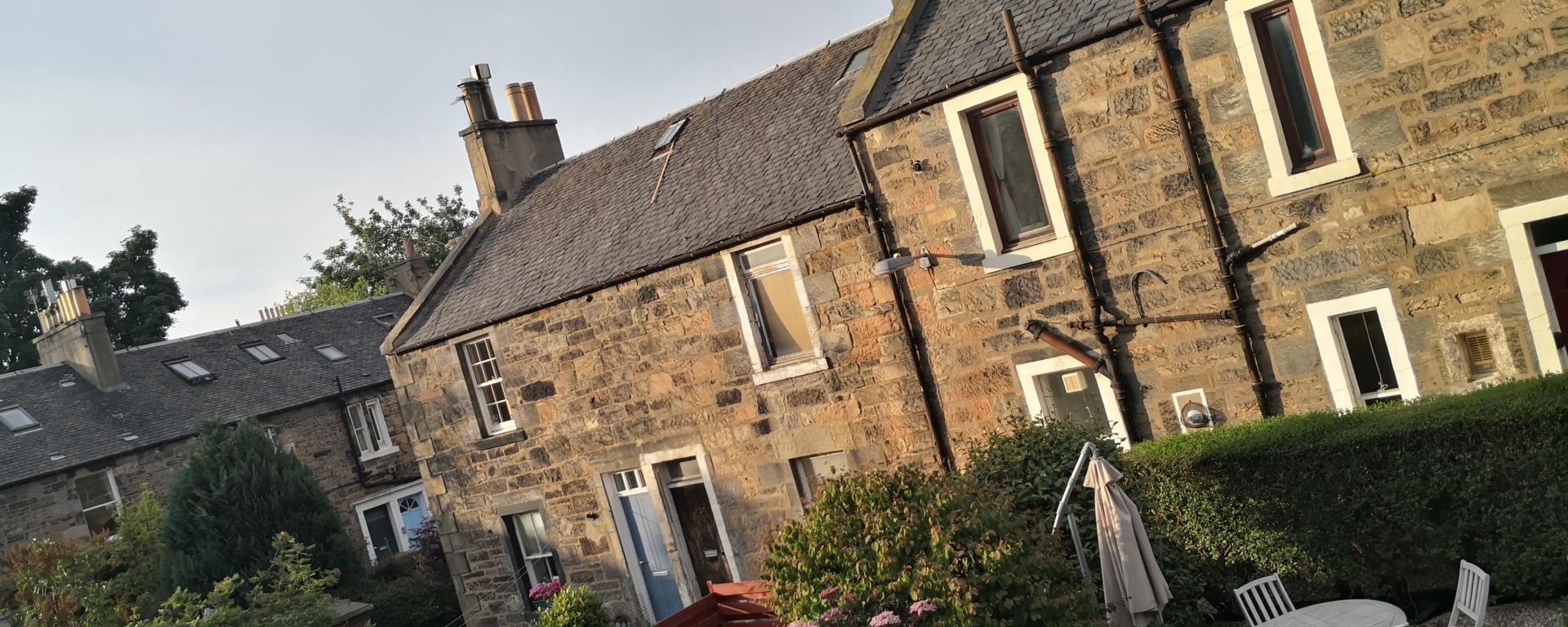
In this context, I mean a group of what many would call maisonettes, scattered around Edinburgh, Scotland. They were built in the second half of the 19th and very early 20th centuries, and are adorable.
More than that, though, they were an attempt to make social change. Scottish cities in the 1800s were pretty grim for lots of folks. Sure, Edinburgh had its fancy New Town, but that wasn’t for normal people. The artisan workers who had made all of those posh buildings certainly couldn’t afford anything like that, and lived in much poorer conditions, in crowded tenements, many families to a bathroom.
In the late 1840s, a group of local clergy felt it was their duty to do something. They purchased a plot of land near Pilrig Street (and a classic execution spot, apparently!) and designed a new set of houses. They weren’t big, and they weren’t fancy, but they were a massive improvement on what had gone before. They looked like proper houses rather than flats. Each home had its very own front door, on one side for the ground floor flat and the other for the upper, and a garden – or perhaps more of a drying green. There were a range of sizes of houses too, perhaps to be rented for a range of prices.
By the early 1850s the Pilrig Model Dwellings had their first residents. There was massive over-subscription for the houses, and it became clear that this was a model with a great deal of potential. Ultimately, the Edinburgh Colonies Building Cooperative was established, and new sets of colonies were built across the city – in Stockbridge, in Abbeyhill for railway workers, in Shandon, near Leith Links, and others. The later houses are generally a bit bigger than the rather bijoux Pilrig houses, and some even have posh bay windows!
You can find out much, MUCH more detail about the history of the colonies here, in this fantastic document. It’s got maps, pictures, stories, layouts, and more.
 The Model Dweller